Axiometrics
The Industry Leader In Apartment Market Research
Home
Company
Executives
Meet The Team
Methodology
Difference
Industries
In The News
Press Release
Employment
Products
Pricing
Student Housing
Pipeline
Property Report
CPS Report
Portfolio Report
Market Report
REIT Product
Forecasting
REIT Forecast
Supply Demand
Advisory
Feasibility
Seminar
Cortland Partners
Markets
Blog
Contact
RSS
Facebook
Twitter
Twitter
Linkedin
Technorati
The Case For Investing In Apartment Housing,
Yale Club, NY, April 11, 2011
Sam Chandan
[MUSIC PLAYING] Good morning, everyone, and I just want to echo Tammy's thanks for your taking the time to come and join us this morning at the club. To be able to talk about the multifamily sector, I think that after I touch a little bit on developments in the economy and in the housing market that relate specifically to outcomes in multifamily, I'm going to pass it on to Ron and Jay, who will be able to elaborate on some of what's going on with the fundamentals. Obviously, the apartment story has been a very strong one over the last couple of years, and it continues to be a sector that performs extraordinarily well, which differentiates it from what we see in other asset classes. But it's also part of a very complex dynamic. One that's characterized by a supply response, in terms of new development activity, that has very specific spatial attributes to it. Where are we seeing that development? How is it being financed? What are some of the issues in secondary markets? What are some of the interactions with the housing market that ultimately are also impactful, or that may be impactful on a prospective basis on what we see happening in the apartment market in the United States today? Inasmuch as those fundamentals have been a source of real optimism about one subset of commercial real estate and income producing properties that has performed and continues, again, to perform very well, there has been an obvious change. And a very clear change in terms of how multifamily is being financed and how investors are also thinking about the aggressiveness with which they might bid for multifamily assets. One of the things that I'm going to elaborate on very briefly are some of the reasons why, as investors, as lenders are approaching the market, they also need to exercise a degree of caution in thinking about where it is that competition to either lend, to invest might tend to exert some upward pressure on the valuation of the assets, where that competition might ultimately lead to some minimization of the potential risks in the market. Because there is still a great deal of variation in terms of the outcomes that we see. It is not the case that every market is characterized by an appropriate balance between the underlying fundamentals and the valuations. And that is going to mean that while we can approach the apartment market, again, with a keen sense of the strong investment opportunity, we also must be careful in exercising a great deal of judgment about where and when it might be appropriate to invest or to walk away from an investment. Because of the fact that the strong fundamentals have attracted so much attention from so many investors, again, requiring that we be a little bit judicious in thinking about how that competition is ultimately driving some of those outcomes and opportunities for yield. Speaking first, then, about the economy. I think the outcomes the economy will see have played a critical role in driving multifamily outcomes. And not just in terms of what's happened with the housing market. There's obviously a very complex dynamic with housing, where either because young families who are normally at the point where we would expect them to make a transition from being a renter to be a homeowner have chosen to hold off on that decision because they think that home prices might fall a little bit further or we'll also see the argument to the market they might be holding off on that decision to become a homeowner because the American dream has been fundamentally altered, and they feel differently about what home ownership implies and whether home ownership is appropriate for them at this point in their life cycle. It could be either one of those things that in some part or in combination is leading to relatively tepid demand for housing. A third critical piece of this, of course, is that household formation rates are being impinged by a lack of job creation in the United States. That it is not just population growth that drives household formation, it's the interaction between population growth and the rate at which we are actually creating jobs that can feed the incomes that can lead families to actually rent their own apartment or buy their own home. Fourthly, it could be that there are constraints in the market. That there may be people who are desirous of becoming homeowners, but who ultimately are finding that their ability to become a homeowner is somewhat constrained by a changing market for financing that ultimately has been characterized by an increase or tightening of credit standards. One that has made it more difficult to access the financing that is necessary to make that transition from renting to home ownership. There is this housing piece. And that interaction with housing, which, again, is critically important. But what we're also going to see is that the way we think about the kinds of investments, the attractiveness of the apartment sector on a broader basis is something that has been influenced by trends that see in the broader economy. And things that are not specific to just housing market outcomes in the United States. We know from the data, we know from the interpretation of the data, whether we're engaging with colleagues at the Federal Reserve or with other investors, that there has been, over the course of the last couple months, a material change in terms of how people think about where we are in the US recovery. And the data tells us that we can feel a little bit more optimistic. We also know that there are significant challenges to that recovery. And some of them will grow in significance over the course of the next couple of quarters as we approach, for example, that fiscal cliff where so many of the tax breaks and adjustments that we enjoy now have the potential to expire and not be extended. At the same time, we know that in spite of the fact that we've grown more optimistic about the recovery because of where the data is, it's also the case that there is a critical missing piece in this recovery. And that critical missing piece is the creation of new jobs. We can take a look at this chart, which briefly tells us that from the time that we began losing jobs during previous recessions, in the post-World War II period, that's going to be point zero. How long did it take for us to lose all of the jobs that we were going to lose in that recession before we then again started to recover those jobs completely? And what you can see is that up until the 1990-91 recession, that process from the day we started to lose jobs to the time we started to recover them to the time we recovered them all and could say, you know what, now we can think of ourselves as being back where we started and start to grow employment again-- well, that process took anywhere between 20 and 28 months. Over time, those recoveries have taken longer and longer. And if anyone thinks of this recession as being different from previous recessions, it's true. Not only in terms of the magnitude and the depth of those losses, but also in terms of the difficulty that we've had in putting people back to work. And so you can see that although we're in a much better place than we were just a couple of months ago, today we are still down about 3.8% in terms of the employment market, which leaves us a little bit worse off than we've been at any point during any previous recession after the second World War. And that's going to be a challenge for us. The combination of a weak employment market, weak housing market, and a variety of other concerns about the fragility of our economic recovery has meant that monetary policy in the United States has sought not only to encourage investment, in people, in capital, it's also sought to offset some of the challenges and mismanagement that we observe in the way that we are approaching fiscal policy in the United States. What you see, then, as a result of that, not only because of choices that have been made at the Federal Reserve but also because of extraordinary uncertainty in the global financial market, treasury rates in particular have remained extraordinarily low. Now, it's not necessarily the case that in helping to keep these rates low through a program like maturity extension, the Federal Reserve just wants money to be cheap for you tomorrow. There's a secondary and probably more important goal here. And that secondary and more important goal is in making sure that during this period, where investors are extraordinarily risk averse and seeking to avoid taking on unusual risks, that they can't go too far in finding those safe havens. Because today, if you invest in treasuries, the result will be ultimately a decline in the real value of your money. Because the inflation rate is running a little bit hotter than what we actually observe happening in the yields for the treasuries themselves. So the Federal Reserve, through monetary policy and other means, has sought to ensure that although you might want to avoid risk, and while the knee-jerk reaction during this period of extraordinary risk aversion might be a flight to safety, and at the extreme that means the purchases of treasuries-- what we also know is that in that environment, in a situation where it would be very difficult for you to invest in something where the value of the asset you're acquiring, the value of those yields, ultimately is declining, they're pushing you out on the yield curve. They're forcing investors to look a little bit further, to take on some risk where they otherwise might not. But to do that so that we have capital flowing into a wider range of investments than would be the case if the yields were higher on the risk-free asset. Well, for investors in today's market, they're having to balance two things. On one hand, I don't want to take on any risk, because the world seems unpredictable. But at the other extreme, I am being forced to take on some risks. I can't go too far. I'm not necessarily going to invest in things where the potential for return, the potential for appreciation is unusually uncertain. So where do I find that balance between what the Fed is forcing me to do in taking risks and assets and investments that might potentially present risks that are too high, given my current level of risk tolerance? Well, there's a happy medium for a lot of investors. And over the last couple of years, that happy medium has been characterized in some cases as core commercial real estate. Our strategy has us buying core in gateway markets. By virtue of the fact that we also have improving occupancy rates and rising rents in the apartment market, even beyond core assets in core markets, part of the strategy that seeks to search for yield while avoiding undue risk taking has seen capital and investment and lending flow into the apartment market as well. And so we have this combination of factors. In the search for safety combined with or balanced against yield, at the same time as the apartment market is experiencing strong and improving fundamentals, a confluence of desires and objectives on the part of investors and lenders has resulted in a strong inflow of capital and credit to the sector. And that is why, in part, we see that there is more activity. Whether it be transaction activity, whether it be price discovery, whether it be improvements in the valuations of the apartment assets that reflect not only the fact that we have those improving fundamentals, but improvements in value in excess of the underlying fundamentals. And for any one real estate, that just means there can be simply stated or observed in the lower cap rate in the market that we have today. So what has this done for us? Well, we know that this flight to core, this flight to quality is something that has been a significant feature of the commercial real estate recovery and the multifamily sector in particular. Because if we were to contrast two indices-- say, well, how might we quantify this, how much we visualize this? We can take one, the Moody's Commercial Property Price Index that captures every sale of multifamily or commercial assets of $2 and 1/2 billion or more, and what that's going to show us is that the market is still struggling, in some cases, to really open kind of momentum in value and recovery. But when we look at those core assets, when we look at those high quality assets that are better represented not by the Moody's Index, but by the Green Street Commercial Property Price Index, what we're going to see there, in contrast, is a market that has recovered an extraordinary share of the value that was lost during the downturn. How can it be that we have such a significant degree of bifurcation in the market? And again, it's a reflection of the fact that at once, investors are risk averse, but are having to move out a little bit further along the risk spectrum in search of yield that they can't find if they simply avoid risk altogether. It's something that characterizes core commercial properties that you'd see in the Green Street CPPI. And it's something that also characterizes an apartment sector, where again, in contrast with what we see in so many other property types, you actually have those improving fundamentals. Part of what's driving that, again, is the complex dynamic with housing. And an element of this that we must concede when thinking about, well, has the American dream fundamentally changed? Well, anyone who is definitive in telling you that it has or has not, and so we will observe a generation of people that will never be homeowners or will seek to become homeowners as soon as the credit becomes available-- but we don't have the data yet that allows us to really think carefully and definitively about how those behavioral choices have changed. What we do know is that across a whole variety of measures and metrics, even if it is the case that young Americans want to become homeowners just as much as was the case a generation ago, changes in the way that we finance housing and the way that we finance ownership in the United States are ultimately going to mean that fewer people become homeowners at the point that we would normally think of them making that transition. One of the ways in which we can represent that is to proxy for the nature of the underwriting standards that, at least in our view, are unlikely to ease over the course of the period of conservatorship of the agencies. And when you look at, well, what are the credit scores for those mortgages that are being purchased by Fannie Mae and Freddie Mac? And what does that imply for the ability of a relatively young household to actually transition into home ownership? Well, when you have FICO scores that now a majority of which are above 740, that might work perfectly fine for a broad cross-section of the United States, but it's not going to work so well when we think about the nature of the credit profile for the young Americans who ultimately represent the net new demand for home ownership in the United States. So this presents a challenge for us, because we know that at least during the period of conservatorship, as we're looking closely at the language and the strategy that's being communicated to us by the Federal Housing Finance Administration most recently in its February strategy paper to Congress, about what must it do to ultimately bring the agencies back to a position of solvency while protecting the US taxpayer, the idea of an easing of these metrics, of making it easier for lower quality credit borrowers to become homeowners, is probably off the table. So this leaves us again in a position where the broader economy and the conditions in housing markets, the conditions in housing finance, are all supporting outcomes in the rental market. What we also know at the same time is that that rental market has been supported, to a significant degree, by the role of the agencies for whom lending in multifamily represents a profitable book of business for them. Whereas their broader housing single family housing book of business may not be. So when you look at that orange slab right there, you can see that up until really a decade ago, the agencies played a fairly modest role in financing multifamily outcomes in the United States. But during the crisis, as other lenders step back, particularly the banks in CMBS, the agencies took a much more significant role, and it's a role that they've continued to play. Where we need to be concerned, in thinking about how we balance potential investment opportunities and cash flow growth against the prices and valuation of assets in the market today, is in that by virtue of the agencies' access to subsidized capital, by virtue of their access to fundraising that benefits from a government guarantee, the nature of lending in the multifamily market and in segments of the market that are characterized by a significant degree of competition between the agencies and other sources of capital-- where there is some degree of crowding out. Because the bank can tell you, I wanted to make that loan, but I wasn't able to because given my cost of capital, I wasn't able to undercut the loan that was being offered by a conduit that ultimately relates back to one of the agencies-- in that environment, the very low cost of capital that we observe and a relatively higher degree of leverage than we would have observed a couple of years ago is necessarily going to lead to more competitive bidding for the assets that we would have observed at previous points. Or in a set of conditions where the access and cost of the underlying capital to lenders in the market was determined privately, or as a function of the nature of the risks of the assets themselves, as opposed to being determined by a set of conditions where the Treasury rates themselves, and the agency bonds with their government guarantees are trading at extraordinarily high prices and low yields. What has that meant for us? It's meant that cap rates have continued to decline. It's meant that in the aggregate, we may not observe that cap rate decline when we look across all markets. Because across all of those markets, we are beginning to observe a greater dispersion of transaction activity. When we look at the cardinal markets-- that will include places like New York and Washington, DC and San Francisco-- very, very low cap rates on average, just above about 4 and 1/2%. Certainly for the assets that we're going to be able to read about on the cover of the broad sheets, we're going to observe even lower cap rates than these. When we look across averages that really capture what's going on nationally, we don't see nearly as much of a decline. And in part, that reflects that by virtue of such a competitive market to finance and develop, we also have a broader range of assets that are coming to play in the market than was the case just a couple of quarters ago. And that change in the quality, the desire on the part of so many investors to acquire multifamily asset, the lower cap rates for the highest quality assets, those things in combination ultimately mean that we have to look more broadly to secondary and tertiary markets, supporting price discovery in those places, but ultimately also then introducing to this pool a much broader range of assets than we would have observed when we saw that, for example, in the cardinal markets, cap rates were unequivocally declining. Part of what's supporting this is, again, that the financing is so extraordinarily affordable, the cost of the financing to the GSEs being a function of the 10-year Treasury in the United States. When we observe, then, over the course over the last couple of months Freddie Mac bringing seven year deals to market, ten year deals as well, and the average interest rates in those deals being significantly lower than anything that we've really observed before. The challenge for us is that whether it be interest rates or the cost of financing or the cap rates, while we might think of this in terms of historic norms, and those spreads being perhaps in line with historic norms, or maybe even just a little bit lower, what we also know is that there's a challenge for us inasmuch as the lower those interest rates and cap rates fall from what we think of as being a normal or a market rate, the greater the cushion that we have to introduce to offset for the fact that over time, at our exit, these rates have the potential to be significantly higher. So tremendous opportunity in this market, because of those improving fundamentals, but also a set of challenges that result from there being a strong degree of competition, that strong degree of competition being supported by that subsidized cost of capital, particularly in segments of the market that are most competitive, at the same time as we also have a relatively myopic set of behaviors in the market around, well, these interest rates allow for this deal to make sense for me today, but not necessarily in every case careful thinking on the part of the investor or the lender about five years from now or seven years from now. When I reach my exist, what will interest rates be? What will cap rates be? What kind of cash flow growth will I experience, and will that cash flow growth allow for me to be able to offset the negative impact, or the drag that is exerted on valuations as a result of the way that they push up cap rates, the way that they might push up interest rates and lead me into a market where all of those things, and that engagement, is significantly more expensive? It's not a feature of every aspect of the market. So many parts of the market are characterized by a more modest degree of competition that allows for us to exploit the significant cash flow potential of apartment properties in the United States. But what we do know, and this is just one way in which we can think about the degree of competition, the density of lenders and investors in segments of the market where that density is highest, where the competition is greatest to acquire an asset-- what we also observe is that particularly on the lending side, that competition is leading to observably lower spreads that introduce a higher degree of risk. One dimension on which we can observe that is just the balance of the loans themselves. At the low end of the market, assets that are relatively small, that are not institutional in quality or in management, and where there are by virtue of those things a finite number of lenders ready to extend credit. At the other extreme, where we have the largest assets, again, some of the best borrowers and some of the best lenders, but a limited degree of competition by virtue of the fact that there's not as much overlap. There are not as many banks in the market today that will make the $30, $40, or $50 million loan. But in that sweet spot, where lending and investment is most competitive, where we observe that greatest degree of density and diversity of market participants, the potential, then, to observe that it is that competition, in and of itself, that is leading to stronger pricing outcomes and the potential for us to make less informed decisions that would be the case otherwise. At that point, I will pass it on to Ron, who will be able to talk about what some of those underlying fundamentals drivers are.
CHAPTER 1: ECONOMY AND CAPITAL MARKET OUTLOOK
Ron Johnsey, Part 1
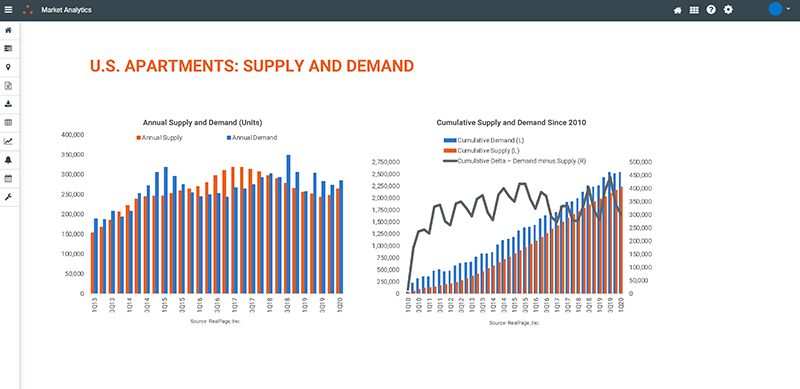
[MUSIC PLAYING] What I want to start out with is what has happened so far this year in the multifamily market. And the numbers we gotten so far year-to-date for March, for 2012, is about 1.83% increase in effective rent. Last year, at this same period, it was about 1.84%-- in 2010, about 1.37%. So there's been a concern in the industry-- is after the downturn we had at the latter part of last year-- is it going to bounce back? And it looks like it is. If we look at just the rate performance, January through March, we think they're up about 2.5%, so they're doing quite well. When we look at the outlook for this year, we're looking at growth being somewhere around 4.9%-- that's up to 4.2% in 2011. We see vacancy rate continuing to fall. It's a great situation where we still have this strong rent growth, and we're also getting very strong absorption. If we look at the three- and five-year outlook, it's still very good-- 4.3% on a three-year basis-- 3.6% on a five-year basis going out. And we think occupancy is going to stay within this-- vacancy will stay between 5.2% and 5.6%. We look at the value situation-- it's starting to come back. This year, 2012, we think it'll be up about 15%. We're moving from appreciation return to more income return as we have recovered from the trough in 2009. When we look at what's driving this-- the higher absorption rate, the increasing occupancy, and this great pricing power-- we see an increasing supply, but it's still going to be well below historical norms. We're seeing increasing rate of job growth. Our outlook is that job growth through this measurement period-- say all the way out to 2016-- is still going to be very modest. We don't see a real robust recovery. We see problems with potential tax increases in 2013. There are problems at the federal, state and local levels with budgets that have to be met. You look at the GDP equation-- you start pulling this money out of the economy-- it's going to be hard for this economy to produce a lot of jobs. That being said, there's still going to be a lot of demand for apartments because of renter household formations. There are a number of constraints-- that Sam's gone through some of those-- it's more difficult to buy a home, and there's other reasons we'll talk about-- why renting is more favorable at this particular point in time. This shows you the supply and demand-- supply being basically deliveries into the market-- adjusted for obsolescence and some other factors. And when you look at that, you can see that pretty much until 2014, we think we're in a good situation where we don't have oversupply, but we think it will hit at that particular point in time. We're looking at something like supply is going to be around 276,000-- let me just get this to work-- at this particular point time. And so this is 2014. But if you look at where we've been historically, it's still, I think, fairly reasonable. You had some spikes here and there. Now, I can paint a scenario that would say it could be better than this, and I'll go into that in just a second. This shows you the trends that we've seen. One thing to point out here is that rents fell down by 6%, but look how quickly they bounced back. If you go back over here and look at this time frame-- and so what makes the difference-- here we had a constant supply of product being delivered into the market, which impacted it. Here we had very little supply. So that, I think, has contributed to this real robust bounce back that we've seen. This shows you the total returns. The bottom here was a minus 33%, but, again, look how it's bounced back-- again, responding to the demand by renter household formation-- pricing power-- translated into revenue, but this is mostly appreciation gain. And then there are markets that have been lagging, which causes the appreciation to fall off, and then we get the income component kicking in, and this gets on out-- this is about 18.4% going down to about 10.7%. Looking at how the rent growth has correlated with job growth. We know it's very highly correlated. You can see here now that rent growth has peaked before the job growth. And this can be attributed to renter household formation-- very little supply in the market. Again, this just shows you that there's an inverse relationship between job growth and the vacancy rate. We're forecasting peak job growth of about 2.8% in 2014, declining down to about 1.5%-- not very robust. And that's supply. Driver for the apartment market renter household formation-- it's been correlated with-- you can see how the homeownership rate has fallen-- almost all the markets around the country. When we look at it by age cohort-- look at the markets, and then you look at it by age cohorts-- the prime renter cohorts have experienced large drops in homeownership, but it was not big to begin with. But it's across all age cohorts. When we break this down further, if this is our forecast of the renter household formations going out through 2016, when you add all this up, that's about a million one, on average, renter household formation. And then when we look at breaking it down and what would apply to conventional apartments, we think that could average around 300,000 400,000 per year, which would be greater demand than what we're seeing in terms of supply, potentially. What's driving this? This is the echo boom generation. You have kids that are 16-- 18-- years of age to 30, coming into the market. And when you break it down and look at this, it really, I think, gives you a great idea of the potential for the apartment demand being really strong into the 2020s. And what happens in 2011-- you were 18 when you went to college. And you look at-- you're probably in an apartment through this whole period after you move out the dorm. Here, you may get some buddies-- get an apartment. You may meet someone and get married, but you look that you're 27. So we're out nine years. And the age of marriage is getting further out. I think it's like 26-- 27-- years of age. And then what might trigger you moving out of an apartment into a home? Well, maybe you have children-- and so people having children at older ages. So you could see into the 2020s a very robust apartment market. Now, what else would contribute to this? The college educated echo boomers have higher incomes. They have incomes in the $50,000 per year range. The bad news is, they also have a lot of college tuition debt, and that college tuition debt is estimated between $25,000 and $30,000 some dollars. And then they also have credit card debt. That's been estimated to be over $10,000. So with all this debt, yet they have the incomes, but they cannot afford to make the down payment because they have the debt. And so this debt has to be worked through in order for them to become homeowners. This shows you how the relationship between the single family multifamily rentals with the vacancy rate. As the owner housing market boomed, we saw a increase in the vacancy rate. The apartment market took off at the same time. They're correlated. And so the vacancy rate went down. And then we go into the bust, and we start seeing foreclosures. And, again, you see the vacancy rate for single families going down as people foreclosed out of owner homes began to rent single family homes. And we also see the multifamily vacancy rate falling because of there's a lack of supply. We all know that single family homes are very affordable, but, again, it's difficult to get the FICA scores-- as Sam pointed out-- to be very high. And you have to have the money for the down payment. Also, the housing market is still soft. You just don't see much going on there in terms of sales. It really hadn't taken off. Now, I'll turn over to Jay. But let me just say one thing. I was talking to Sam. He was pointing out the "Wall Street Journal" had an article about AIG getting into the real estate business. They're going to concentrate on apartments. And I think AIG is 70% owned by the government, and so, they're going to go buy apartments or build them, and then they'll get loans from Fannie Mae and Freddie Mac, and then they're going to take that debt and bundle it up and sell it off, and then the Federal Reserve's going to buy it. I thought that sort of strange. But, anyway.
CHAPTER 2: US APARTMENT MARKET OUTLOOK
CHAPTER 3: US APARTMENT MARKET DRIVERS
Jay Denton
[MUSIC PLAYING] OK, I'm going to take a little deeper cut on the informational realm and look at how particularly markets are performing, how asset classes are performing, business markets. And then we'll actually break down how revenue managed properties are performing as well. If we do a quick recap of the markets and those various things I just spoke about, and we look back at 2011, what were the key trends we saw? Well, when we looked across the country, it was pretty easy to see what the hottest spot in the US was. And that the San Francisco Bay Area, whether it's San Jose, San Francisco, Oakland, it didn't matter what product class, what submarket. They all performed extremely well. The little more surprising part is when you go to just right below those markets and you see Dallas, and Charlotte, and some of those low barrier type markets that were performing just as well. What helped them do that? Well, they were essentially a high barrier market, like most places in the US. Very little was constructed during this period. Now, some other markets decelerated. So it was really odd to see Dallas and Charlotte have better rent growth than markets like DC and New York. We just haven't seen that very often in the past. Those markets just sort of ran out of gas in 2011. We think they could be markets that come back a little bit that, though, this year. We also saw the C properties begin to recover. If you look and you see when a market starts to recover, you're typically going to see the A and the B properties come back first. And it takes the Cs a few years to really you know get their feet back and start pushing rents. And we started to see that in 2011. In 2010 Cs had about 2% growth. That double to about 4.2% in 2011. But it's not consistent across all markets. So there are markets like Houston and Atlanta-- and we'll look a little more at Atlanta in a minute-- and Memphis where the occupancy rates are still very low. You're talking like, high 70s low 80s. And it's very hard for them to push rents. And to start moving that occupancy rate upward. I'm gonna focus a little more before I turn it back over to Ron to talk about the forecast, I'm gonna talk more about the construction, what we're seeing there. But we started to see it come back a little bit in the summer 2011, at least some things get started. OK, so what are we looking for for 2012? I'll skip past this because I'm gonna hit all these points on the slides coming up. So far, as Ron mentioned, we're seeing very strong results early in the year. It's very similar to what we saw the last two years, which is a great sign. So a couple things to note here, obviously, how strong the market's looking so far. Notice how the REIT properties always outperform through the early part of the year, compared to the national average. I attribute essentially all of this to them using revenue management. Of the twelve companies that we follow, they're all either fully deployed or they're starting to deploy revenue management. Eight of the 12 are actually using LRO. So if I look at how this year's going to play out on a year to date basis and compare that to last two years, we see it being very strong, even stronger than what last year was. Really, it's going to be very similar to what we saw in 2011, except for when we get to the middle part of the summer, we're not going to see that sort of fall back that we saw as the US debt crisis was really heating up. We think it will extend on for another month or two, and then have more of a seasonal decline, like what we saw in 2010, rather than that so much sharper decline that we saw in the last half of 2011. Now, again we start breaking down asset class information. So take the national numbers. Star splitting it out in how A's B's and C's are performing. As I mentioned, what you see if you look back in 2004, we saw the same trends back then that we're seeing right now. So you had the A's and the B's really starting to escalate rents. But it takes the C's a little while. You have to have that shuffle happen, so from A to B, and then down to C. And it takes a little bit of time for that to happen. After that the classes actually grow at a pretty similar pace. So if you look from about 3Q '06 all the way through when we hit the trough, the different classes performed very similar. We'll look at a few markets in particular. This is-- I won't go through every market here. You guys have the sheet. So you can dig through all the numbers. But just take a few things that I would look at. How are effective rents, how's the growth different from A's to C's within different markets. And some of them, they're very similar. And others the A's still have the clear advantage. Something I find interesting, if you look down at Phoenix and San Francisco, they're right beside each other. If we were standing here one year ago and I had this same slide what you would see is Phoenix A's were actually outperforming San Francisco A's. They're up about 10%, 11%. But we saw a big pull back in 2011 in Phoenix. San Francisco went the other direction. So you have 17% rent growth there. Look on the occupancy side. Where's there's still a spread between the A's, B's, and C's? We're seeing it mostly, as I mentioned, in markets like Atlantic. Phoenix still has a little bit of a gap. But it's actually closed a lot over the past year. But taking a different little deeper look at Atlanta. So we have a file that's really accessible. And so I took it. And it has all the occupancy rates for every property we're tracking in Atlanta. And this is all February information. So literally each dot you see on here, we surveyed every one of these guys. And there's actually a lot more not shown here. What I did is I'm just showing properties with the top in occupancy rates, so those 95% or above, and then the ones with the lower occupancy rates. And so those are mostly going to be C properties in the blue that are below 90%. And so if you look in Atlanta, there's still a good story. So if you look sort in the midtown, downtown, Buckhead area, you see properties are very, very well occupied there. Where are the blues falling? Well, they're falling outside the loop. They're falling mostly on the southern part of the city. So we look at this. We have clients that look at this and start looking at just different investment decisions. So if I look on here and I see a property sort of on the northern part a town, where there's a blue right next to a bunch of red. What's going on with that property? Is it a potential acquisition target. A lot of people are concerned about DC. The pipeline is starting to ramp up there. The market took a little bit of step back in 2011, as I had mentioned. And so how's it going to be able to handle all these new deliveries? Well, if I apply the same metrics to DC, you see red throughout the whole map, very little blue. And where there is blue, it's concentrated in one area. It's on the southeastern part of the metro there in Prince George's County. So just looking at it this way, it looks like D.C. could perhaps absorb that supply a little better than if the same type of supply hit a market like Atlanta. So what are we looking for for leading indicators? Again, if we went back a year ago we had been talking about DC. And in DC we saw the A properties start to pull back on rents. The rent growth just wasn't as good. And so throughout 2011 we started seeing other markets showing that. And these are the markets that are on the earlier wave. So you have markets that were really led out of the recovery. And then you have several others that are lagging, markets like Southern California, a lot of the Florida markets. Those still probably haven't hit their peak. A market like San Jose probably has. And the way you spot where it's hit that peak early is watch what's happening with the A class. So on this chart, it's the blue line. And what you'll see is the blue line was around 15% or so mid-summer. And now it's settled into only 8%. It's still great. Every other market would kill for that. But you can see that it's starting to slow. And so what happens is you have A's starting to go down, C's improving. And so if you just follow that overall market number, you don't realize the markets actually starting to decline until a few months after the A's would have told you that's what's happening. Austin, Texas, by the way, looks very similar to this. OK, now, how does revenue management figure into this? It's a great leading indicator. So if we go back to 2005, 2006, we actually changed our methodology somewhat. We went from quarterly surveying on primarily the apartment rates. We were surveying everything quarterly. The apartment REITs were the early adopters of revenue management. And we saw those guys raising rent. So Archstone-- I use it as an example all the time-- we'd survey in Archstone property in California and the rents would be up 20% from the last time we called. And we said, man, we've got to get more data points. It's crazy how fast they're pushing rents. And so we saw it in '05, '06. They really led with the best rent growth of all the properties we tracked. Then we got to the summer of '08 and what happened? Companies like Equity Residential, we were following them. And we started to see them under performing their markets for rent growth. What we didn't realize at the time, is what they're doing is they recognized the diminishing demand. And so they started lowering rents first. They were able to maintain a higher occupancy rate. And then once the market crashed, they were well occupied. And the other guys ended up having to lower rents as well. The difference is Equity was able to maintain 94%, 95%. And everybody else was stuck at 90%. I'll show you where that happens on here in a minute. Fast forward to the latest example. You get to March of 2010. The apartment market was starting to get back on its feet. And the thing we're looking for is year over year rent growth. When does it turn positive because that's a great indicator of when a particular company or portfolio is going to turn positive for revenue growth. It leads by about a year. So we saw the national average for effective rent on an annual basis, it turned positive in May of 2010. Well, if you take a few steps back, there are actually five REIT companies that had already turned positive. Four of the five actually used LRO. And the fifth one does now. So they were properties for the most part that already deployed revenue management systems. Now, what I did here is I took the national numbers. And so really you need to get deeper. You need to go into particular markets, even submarkets and see how they perform. But at least break it up by class. And so what you'll see here. This is a revenue index where we combine rent growth and occupancy growth into one number. And we see how it transfer properties using revenue management versus the ones that are not. And it's a no brainer with the B's and C's. They obviously outperform. Most of the time when I show a chart like this, they say, well, what about the A's? What happened with them? Well, if I break out the components, this starts to show that effect that we saw that began at the end of 2008 and it ran through 2009. If you notice the top right chart, the class A properties-- notice as we are entering the recovery period, the A's using revenue management were still up at 94.5% and 95% occupancy. The other guys were more at like 92.5%. And it took them throughout all of 2010 to really get back that occupancy that they lost just a year or two earlier. The other thing I find interestingly on this is if you look at the occupancy rates, the top left it, doesn't matter if you're in A, B, or C. You have consistently strong occupancy rates, which is going to lead less volatility in your rental revenue. OK, now when it comes to rents that's where you want to see the volatility a little bit more. And so if you look at class A and you look at the guys on revenue management, that's the perfect trend we like to see on does it really work. What you see is they push rents faster during the earlier periods in the year, so when most leases are signed. They start pushing rents faster. It doesn't work by renting a $1,000 unit for $2,000. What happens is if we're all standing here today, and you see the lines match typically around the fourth quarter, so they kind of end up coming back to market by the end of the year. If we're sitting here today and everybody's at $1,000. Well, we know everybody in the market's going to be at $1,100 by the end of the year. But those guys use in revenue management are usually there by April, May, June. And so they sign more leases at the top end rate. And that's really how they boost rental revenue. Also, the interesting thing here. I'm talking about Class C growth. We think Class C is going to improve. Why do we think that? What you see is the properties using revenue management they've already done it. Even on the A's, I feel like if you look at the A's, it looks like nationally we probably left some rent on the table because the revenue management line did not come all the way back down to the traditional line. So I think manager were less optimistic about pushing rents when really they could have gotten a little extra money. Now I broke out just a couple markets here for Dallas. Just looked at just that revenue index. You see that across the board revenue management outperforms. And then in DC the thing I found that really interesting-- in most markets we see that revenue management maintains a higher occupancy rate. But it's not really about maintaining a higher occupancy, it's the optimal occupancy. And so if you look at class A and class B, what you'll see is the traditional guys actually ran above the revenue managed properties for a period of time. And so I found that very interesting when I looked at it. Now I'm not going to go through all of these companies. But just to show you since the REITs are mostly using revenue management again. Not all properties have been revenue management rolled out to. But AC and BRE were the last two adopters. And they're rolling LRO right now. But if you look at it. I have a national line. So that's the purple line. That's if we take every property in the database, roll it all the way up. That's the national number. If we then just look at markets where REITs operate, that'd be the one above it. So the REITs are typically in markets that perform just a little bit better than the national average. That will probably break apart over time, as you start having your more core markets outperform. Right now we're in a little bit different period because of such little supply in markets like Dallas and Charlton and a lot of markets in the Southeast. But then you see the REIT properties. And you see that by far they outperform both of those. So there are several companies listed on here. Usually the one I point to is Equity Residential. Again, it looks just like that national line, where you see that just perfect they raise rents during the early part. Then they come back down and become more competitive the later part of the year. Now, the last thing I want to focus on before I turn it back to Ron talk about the forecast would be what is going on with new supplies. The biggest question we get asked, where's it coming? When's it coming? How much is on the way? The numbers are still relatively low. We're not back to where we were the middle part of last decade. But they are starting to move upward. We're tracking right now properties that are either planned or under construction in 180 markets across the US. And so we're surveying these guys every day. We're finding out who's doing the deals? How many are they doing? When are they doing them? When's it going to be completed, first move-in and so on. That was a big national map. And yeah, you can see where the coverage is nationally. But when you start zooming into the markets, where is it being concentrated? And it's concentrated by large in the urban core in the different markets. So what I did is we track about nine or so submarkets across the US. And I have the number for how many properties are under construction in each one of the submarkets. So all I did is I took the list and I sorted with the ones with the most construction at the top. That's this list. So if you woke up this morning and main question you wanted to know was where's construction happening, it's in these particular places. The thing to look at-- I'll talk about urban core and without having to know our specific geographic boundaries for submarket. Look at the names of them. Look at how many have downtown or center in the name. That tells you where they're at within that submarket. There are others that are urban as well. They just have more of a name that's more indicative of that part of town than a generic downtown name. We also grade every submarket. And so we do this by looking at the level of rent that submarket is able to achieve versus the rest of the MSA. And to get an A grade for the submarket it's very tough. It's an exclusive sort of club. There's only 13% of that 900 submarket count that qualifies as an A submarket. And you'll notice that most of these are in the A category. There a few B pluses, which is still a great submarket to be in, but very few B, B minuses. And by the way, this isn't everything with four or more properties under construction. I tried to limit it. If I, plugged in all of DC, you'd have a lot more DC markets on here as well. So when you roll that up, and I take all the 900 and I not roll them up, what you'll see is the red bar, the one on the left is going to show you by and large everything being done is being done in those top tier submarkets, which is going to be more of your urban core. And that was not the case if we go back to 2006, 2007, 2008, 2009. That's not really what was going on. It was more spread out throughout the metro. And so if we take Houston as an example. I plotted all the properties in Houston that were delivered between '07 and '09. So yeah, in Texas we were still delivering properties into '09. You look here and it's spread throughout the whole metro. So it's going on in A submarkets, B's C's, everywhere. You look at today, and it's all right around the center part of town. So we talk about supply is low. And yes it is low. But is it low everywhere? So you take a metro and you zoom in and see where it's happening. And it's not as low as it seems if you look a certain areas in town. So what I did, I went to our website. We recently rolled out this feature. And so I just plugged in an address. I don't know many people are familiar with Houston. But I plugged in an address near the Galleria Mall, which is kind of in the middle of that submarket. I said, OK, it's more of an urban areas, so let's just go out 3/4 of a mile. And so you're going to see in the red dots, these are some existing properties that are there. But then notice how many are being planned or are currently under construction. There just as many under construction and planned as what we're tracking that's exist. OK, so is this a good place to build right now? Maybe, maybe not. There are more factors you need to look at. But this starts to worry me a little bit. What happens if you go out to the suburbs? So I went out on the Northwest side of town. I expanded the radius search, looking at bigger geography because that's what you do in the suburbs. I went five miles out. It pulls in a ton of existing product, one property under construction, and of the 2,300 properties we're tracking across the US, none of them are within five miles of this area. So is that the better investment strategy? Again there are more things to look at. And part of it's going to be what our forecast is. So I'll turn that over to Ron.
CHAPTER 4: SHORT-TERM OUTLOOK, FOCUS ON 2012
CHAPTER 5: DISECTING APARTMENT PERFORMANCE BY CLASS
CHAPTER 6: CASE STUDY OF PROPERTIES ON REVENUE MANAGEMENT
CHAPTER 7: APARTMENT SUPPLY PIPELINE
Ron Johnsey, Part 2
[MUSIC PLAYING] OK-- we're looking at the forecast for 2012. The markets that are in the pink are the ones where we see the growth rate slowing down. So you've got-- Oakland will be slowing down-- San Francisco to San Jose, slowing-- Denver-- Boston, Charlotte, Austin, Dallas, and Seattle. Seattle's sort of a wash-- about the same. Markets that are really increasing strongly would be-- Tampa picking up, Las Vegas starts to come back very strongly. We see about a 2.1% increase this year from last year for New York City. Phoenix comes back a little bit-- LA, and so on. The other thing, too, to look at is that in every one of these-- for every one of these markets, the vacancy rate is getting lower. And so this is really strong. One of the things that we have is that this is a year we call filling in. And it's filling in the C product, because if you pull the C product out in 2011, the department metrics would be much stronger for the A and B properties. So this year, those class of products are very full, and so we're going to see the C product get fuller-- more rental increases-- and that's going to help some markets. This is a way that we look at which markets having the best rent growth occupancy-- where you want to be. These are the Northern California markets, then you end up with the Southern California markets here. This is the quadrant that's the strongest. This is Newark, Boston, New York. And then you've got Miami, Fort Lauderdale, Orlando-- these would be the stronger markets. These markets, again, the seize caused these markets to have a little bit less-- Houston-- they have a little bit less rent growth and occupancy. They have more C properties in those markets, and there's more of a structural level of occupancy in these markets because of that C product. Looking at where we're going to see most of the job gains-- you see that Houston on a percentage basis-- these markets here would be your better ones. Let me just tell you, it's hard to read that. You've got Houston, Dallas-- this is Austin-- this is Phoenix-- Austin-- this is Salt Lake City-- Raleigh-- this is Charleston-- over here, West Palm Beach. When we look at which markets have the potential for more development, the markets that are the strongest are the ones over here in this quadrant here and down here. Another idea is to say that if you're going to invest, markets have certain characteristics. And what we've done is look at the NCREIF data-- look at the total apartment return index-- calculate the data for a number of markets. And so what you end up with are markets that have high betas and markets that, let's say, have lower betas. And it doesn't mean one is necessarily better than the other-- it does mean that you're checking out different levels of risk when you do that. So, for example, if you're in one of these high beta markets-- here-- you're going to see more volatility. You can look at the current total return versus the minimum, and it's really-- in San Francisco-- it's really gone up quite a bit, but we're still well below the max. And so you can see that, yes, we've had some nice gains, but we're still below the max. These are more of what I called strategy plays. Most of these areas, except for maybe Denver-- Austin-- are really high-end markets-- very difficult to buy in, build in. Takes a lot of money-- the product's very expensive. The low beta markets are more of steady income-- you can ride out the cycle. It's not going to be too deep. You look here, you still see that you've got some upside in these markets left, but you don't get as much revenue growth. When we plot this on the map, you can see how these markets shake out. And the idea is to build a portfolio where you maximize your return with minimal risk, or you may want to risk, and so this paints a picture for you where you might want to be. And that's a little bit more of that. One last thing to finish up here with is-- we've been asked numerous times about-- is there a bubble in the apartment industry. And I would say, right now, there's not a bubble. I don't see a bubble. But when you have the Federal Reserve keeping interest rates so low-- cap rates-- then low-- that inflates values of properties. And with this inflation of valued properties and financing being so cheap, there's potential to take advantage of that. And so, if we're going to get into a bubble situation, I think the things to look for is, like when lenders start making loans with less than 1.2 debt service coverage. The loan to value ratios go up from 75%. You have interest only loans. You have going in and going at cap rates that are very, very similar. When we start seeing those kind of changes in the lending market, then that's when you get worried. When you see these lower cap rates-- if the cap rates are lower than their cost of capital, what are they up to? What is the investor up to in that particular situation? Another thing to look for with lower cap rates is condo conversions. So if we start seeing those types of trends happening, particularly in the lending market, then there's some issues. Amortization is another good one. We want amortization. We want to start paying these loans down so that we have more coverage of the debt over your holding period. Another way to look at this situation is, look at the markets where the values lost have been recovered the most and also have high revenue growth. So these markets might be potential bubble markets, but they do have high revenue growth that can somewhat offset that. The values haven't recovered and they have higher revenue growth. So these are probably a pretty good situation for not having a bubble. Here, the values haven't recovered-- lower revenue growth-- they're just not as robust-- no bubble. And these are sort of problematic. The values have recovered, but there's not going to be a whole lot of revenue growth. OK, I guess with that, I'll turn it over to Tammy. [MUSIC PLAYING]
CHAPTER 8: LONG-TERM OUTLOOK AND RISKS
Andrew Rains
Hi. Good morning, everyone. As Tammy said, my name is Andrew Rains. I'm the managing director of the multifamily business unit for Rainmaker. So thank you very much for coming out this morning. I will let you know that at the end of my presentation here, we'll ask Sam and Ron and Jay to come back up, and there will be some time for some Q&A. So if you have questions, we'd be glad to answer those at the end. So as I travel around the country and get to meet with a lot of different real estate companies, multifamily companies, I meet a lot of "er" people. And what do I mean by "er" people? People that say, hey Andrew, I want a higher revenue lift. I want a bigger valuation. I want to be able to make smarter decisions. And so I understand where they're coming from. But and then looking around the room here, I see a lot of people in the room here that are really "est" people. You guys want the highest revenue. You want the best valuations. You want to be able to make the smartest decisions. And so I understand that. I've been fortunate to work in the real estate industry now for over 20 years. I worked with companies like the Irvine Company out on the West Coast, CB Richard Ellis, and we had those same kind of discussions. And so as we would meet, we would ask ourselves a question. What is the number one thing I can do for my portfolio that will have the greatest impact on revenue and value? So just like you guys do with your companies, you get around and you brainstorm, and is that making capital improvements, is that the remodeling the kitchen, is that a better resident program? Those are the kind of discussions that we'd have to create that short list. And as we created that short list, we'd ask ourselves another question. Will the number one thing work equally as well in a up market as it does in a down market? Because as we've heard from the gentleman before, the market does look well for the next couple of years, but at some point, it's likely to turn. And we want to make sure that it performs both well in a up market as well in a down market. Well, I tell a little personal story here. Last week, I was on vacation with my family. I have a two teenagers, and we did a beach vacation. And at the end of one day, we had dinner. And there was a small casino there, so my daughter and I walk into the casino. And I just said, hey, would you like to just try a slot machine just to see what it's all about? And so she said, sure. So I gave her $10, and she put $10 in the slot machine. She pulled it once. She pulled it twice. Sure enough, what happens on the third pull, she wins almost $200. So she's excited. She's doing the quick math in her head that she just got a 20x return. Well, as I sat there watched this, I thought, you know what, that's exactly what our customers are experiencing with revenue management. They're really excited. They're getting great returns. And they, like my daughter, got that same 20x return. The only difference is, my daughter's was all with luck, and our customers are with a very sophisticated model that's been developed over the past 10 years with the help of our customers as well as some greater PhDs that have helped write these algorithms. So what I'd like to do is to spend a few minutes today talking to you about how does revenue management work, who's using it, and why is it important to everyone in the room. In the room today, we have different people that are doing lending, acquisitions, analysts, asset managers. And we believe that this is, by far, the number one ROI that you can apply to a portfolio. So how does it work? Well, it starts with the on-site staff. They're doing their day-to-day job. They're meeting with residents. They're executing leases. They are gathering traffic information, guest cards, seeing what's going out into the market, looking at their competition. All of that is going into their property management system. Then on a daily basis, LRO reaches in at night and pulls out that key data, runs it through the algorithms-- we actually have approximately 150 parameters that we look at for every single unit across everyone's portfolio-- calculate the optimal rent, and then push that back before the staff comes in the morning, back into their property management system. We're actually on a daily basis producing over 400 million prices on a daily basis for our customers across all their portfolio. Our customers then can take this information and use it as a great tool to optimize the revenue for their owners. So a couple of key on how does it work. Number one thing is, it takes into account supply and demand. We look at the current inventory of the units that are available, but we also forecast a supply. What is the renewal percentage going to be? How many skips are there going to be? So we get a good view of supply. And then we look at the unconstrained demand. How many people are coming to visit the apartment? How many people are looking at it online? How many people are filling out guest cards? And we determine the optimal place between supply and demand. We also look at the forecasting without emotion. For the on-site staff, pricing can be very emotional for those that are doing it manually. Quite often, we hear the story that there's a resident who's been in place for four years. The leasing agent and the property manager knows that resident very well and has maybe been giving them small price increases. But now, the market has gone up substantially. The resident comes in for that increase, and it's a very emotional decision to determine, can i really raise that person's rate up to market? LRO comes in and does that without emotion. And we hear frequently from our customers that just the renewal process alone drives significant revenue for them. We heard Jay talk about how revenue management in LRO is really one of the best leading indicators in the soft market. Archstone, who was the original user of the software and who helped develop it, has actually been on it now for about 10 years and has gone through two down markets with being on revenue management. And they feel like it's been equally effective for them through the down market as it has been a up market. And then finally, we offer flexible lease terms, 2 months to 13 months, so that's great for the resident. I know, for myself, most of my leases in my life have been either 6 months or 12 months. But there may have been times where I wanted a four month lease or an eight month lease, and now we can provide that for the residents. So here's an example. I know in meeting a couple of you coming in today, you said that you either worked with Alliance or had joint ventures with Alliance. But we started working with them a couple of years ago. They were listening to some of you, their customers, who said, really, we need to be able to increase the value for our owners. And so they've applied LRO. They've now been on it for about a year and a half. And the feedback that we've received from them has been that they've outperformed the market by 4% to 4-1/2%. So we've heard that the market has been moving up in a lot of different areas of the country, but Alliance has seen a 4% to 4-1/2% increase above what the market has been performing. So let's talk about who's using LRO. You see here on the top left-hand side that almost 3/4 of the REITs in this country are using LRO. As Jay mentioned, two of them made decisions last year, BRE and Associated Estates. One is fully deployed, and one will be deployed here quickly. In the middle is just a small representative list of some of our customers that are either fee managers, privately held, etc. And then here on the right are different institutions that are using the software, either directly with us, through a JV partner, or through their third-party manager. One key point that I'd like to make here though, is that if we were having this discussion a couple years ago, our customers represented about a half a million units that they either owned or managed. Today, that number is over 2 million units. And we fully expect, by the end of this year, that number is going to represent about 3 million units. So we are seeing tremendous adoption of revenue management across the industry, because of the significant impact that people are seeing on their portfolios. So let's just talk about three key benefits that our customers tell us that revenue management provides to them. Number one is in the area of discipline. Number two is in the area of transparency or access to information. And number three is in the area of revenue lift. So in this area of discipline, revenue managers collaborate with the on-site staff on a weekly basis. They are reviewing these numbers every single week, bringing tremendous discipline to understanding what's going on in the market, what's going on at the community that maybe LRO can't see. Is there construction going out in front? Who are we losing deals to? What's going on with the competition? So that discipline goes on every single week. Couple stories along those lines. Number one, I've multiple times from companies that are pricing manually that say, we set our prices the middle of the week. Maybe they've got six two-bedrooms available to them, and they set the price of $1,500. Some couples come in on Thursday and lease four of those two-bedrooms. So now, going into the weekend, they've only got two two-bedrooms available. They said we would never, ever receive a call from the on-site staff saying, can we increase rents? That call would never happen. It's contradictory the way the on-site staff is compensated, because they're compensated to get deals done. So they're leaving dollars on the table. As a follow up to that, I was at a multifamily executive conference about a month ago, and the CEO of Sirius said he has to explain to his staff and get his staff on board about the importance of that $25 increase or that $50 increase. To the on-site staff, $25 doesn't sound like too much, right? We can go to a small dinner for that or something like that. But he has them grab a calculator, and say, OK, take that $25 times 12 months. How much does that equal in annual increase? Times the number of units that we have in our portfolio, do that math. And then apply the cap rate to that, and then they can quickly see a pretty significant number of how that $25 is impacting their whole portfolio. One last comment on this is that I recently had the opportunity to hear a presentation by Jim Collins, the writer of Built to Last, Good to Great. He recently came out with a book called, Great By Choice. And in the book, he identifies companies that have outperformed their exact peers by 10x. So he identifies the companies, and then he says that they've spent the last 10 years trying to identify what was different about those companies that outperformed their peers by 10x. They identified a few things, level five leadership, being productive paranoia. But one of the key areas was this idea of discipline. And he uses the analogy of how the South Pole was discovered 101 years ago, and how the explorer, Amundsen beat his competitor to the South Pole by doing a 20 mile march every single day. And he said that companies that have this fanatical discipline have had the same success. I know when we recently talked to Equity Residential, they said the exact same thing, that they really attribute a lot of their success, after having read the book, to this discipline that they apply to their pricing. And so although our customers love the revenue lift, the pricing discipline that they have now applied to their portfolio is a huge advantage to them. This is an example of a company out of Philadelphia, Resource Residential. And they were looking for exactly what I just described, that disciplined, systematic approach. And since they've implemented LRO, they've seen over a 9% increase in rent growth. So now, let's talk about access to information. How do we make those smartest decisions? How can we see the trends? How can we identify the indicators? Well, we provide our customers a tremendous amount of data, both at the site level, for investors, asset managers, lenders, etc. So here, you can see the trends. This is the rent in place, new leases, renewal leases, as well as the renewal percentage across the top. This is a hard report to see. We get your copy of this. But this is an asset management dashboard. What's going on within my portfolio? What is the square footage? What is the rent per square foot? How many renewals have I done? All of this is in a single dashboard. And I just want to point out, a lot of the institutions that we meet with are using multiple fee managers, and they're getting the information in silos from those fee managers. We can provide a report that will consolidate this revenue data across all of your fee managers. Jay talked about a leading indicator being quarter over quarter or year over year analysis, and so here's a quick snapshot. And you can look at it by hierarchy, by asset class, A, B and C properties, by region, all of that here in a quick snapshot. This is a great report that the on-site staff loves. They're able to see the old and new differential. So what was the resident at move-out paying, and how does that compare to the resident who had just moved in. We can look at occupancy, again by region, by market, by sub-market. And then here's a pricing trend report. When the pricing revenue manager meets with the on-site staff, this is one of the dashboards that they look at. I won't spend a ton of time on this. But just to explain it quickly, this top line here shows exposure. So looking back for the last three months, we can look at what is the exposure for less than 30 days, more than 60 days or less than 60 days, and then more than 90 days, And how is that trended over time. So we can see is our exposure or our available units coming online trending up or down. This next graph here shows how are we doing against the competition. So the on-site people identify their five main competitors by bedroom types. So maybe I've got these competitors against a one-bedroom, these competitors against a two-bedroom, but by units type, how my pricing compared. And you can see where, like in this example, the competition has stayed flat, where the property on revenue management just keep pushing rent, because the exposure is so low, and they're in a position of pricing power. And then this one here is a really exciting graph, where once we've rolled out revenue management, we can take our corporate strategy-- and our customers, hundreds of customers, all have different strategies-- but once they apply that strategy and configure the system to work for their portfolio, then we can look at how many of the leases were compliant leases, or basically lined up with the prices that LRO recommended. And those are represented by these green bars. And then how many were non-compliant leases? Those show up as a yellow bar. So we can see exactly how the fee manager or the on-site staff is performing. This here is a very exciting chart to look at, and that is when should leases be expiring. So LRO comes in and takes a look at what is the optimal number of leases expiring by month. So if I'm in Chicago, I know that I'm going to have a better chance of renewing or a leasing up units in June versus January. So these red bars represent how many leases I want expiring per month, and then the blue bars represent how many leases are actually expiring per month. And then LRO will come in and price and encourage or discourage more leases based upon how these bars are lining up. So now, let's just talk quickly about the revenue piece. This is actually a slide that AXIOMetrics prepares. But you can see it goes back to 2008. The blue line are the REITs that are on LRO. The red line here are the REITs that are on our competitor product. And over this period of time, the REITs that are on LRO-- you look at this green bar here-- have outperformed the REITs that are on the other revenue management product by almost 3%. That represents tens of millions of dollars in revenue and hundreds of millions of dollars of valuation if these other REITs had been on LRO and performed the same as their peers. This, another example here, is Holland Residential out on the West Coast. One interesting thing about Holland is that they went out and surveyed about 150 properties that were on different revenue management products before they made their decision, found out what the on-site staff liked, was it easy to use. And then after that due diligence period, we were fortunate to have them select us. So if I were to summarize all of this into a couple of bullet points, why is it important to you that are in this room what is the impact to me and on my portfolio? Well, we talked about pricing discipline. We talked about access to information. But here's a slide that shows for a client, 17,000 units, has a occupancy of 95%, average monthly rent of $1570, and a cap rate of 5%. Well, we put in a 3% growth. A lot of our customers are experiencing higher than that, 4%, 5%, but just at a conservative 3% growth, that would mean that they would grow revenue on an annual basis $9 million, which is $24,729 on a daily basis. So if I knew that there's one thing that I could do-- I go back to that initial question I asked, what's the one thing that we can do? We can get a 20x return and add $24,000 on a daily basis to our bank account. And then, what's that mean to the valuation at a 5% cap? I would have just increased the value of my portfolio $180 million. So pretty exciting stuff. It's really been, for me, the opportunity to see how the collaboration between the on-site staff, the pricing manager, great people, with they're great processes and a great tool can come together and deliver the great results. And for me, I had a little personal story I'll share with you and wrap up by saying that, I saw this in my own life 22 years ago. At the time I was dating my wife. We weren't married at the time. And she started feeling ill, went on for about three weeks. And she ultimately got admitted into the hospital. We were living out in Southern California. And once she got in the hospital, within 24 hours of being in the hospital, she became 100% paralyzed, couldn't move anything, couldn't move her little finger. She stayed in that condition. She was on life support for three weeks. She had a disease called Guillain-Barre, a pretty rare disease. And so she was hooked up to maybe 12, 13 things. They weren't sure that she was going to recover, but today, she's fully recovered. We've got the teenagers. And I remember meeting with the doctor. And he said, you know what, Andrew, he said, she's going to be fine. She's going to recover. It's the combination of these great doctors that we have here on staff, all of these great tools, these great applications that we can apply to Janice, and then we're going to get great results. And so I got to see that in my own personal life, and now, I get to witness it on a daily basis with our customers applying revenue management to their portfolio. So with that, I'd like to say thanks and invite the guys to come up for some Q&A.
CHAPTER 9: OVERVIEW OF LRO SYSTEM
CHAPTER 10: CASE STUDY FROM CLIENTS
CHAPTER 11: LRO PERFORMANCE & REPORTS